You can buy UPC codes from GS1 US, the official source, or from a reseller of codes from older UCC prefixes. GS1 US charges $30 once for one code, and a prefix charges yearly. Resellers charge a few dollars per code with no renewal. Your selling channel decides which one fits.
A quick disclosure before anything else: GetUPCCode sells reseller codes. Several sections below tell you to go to GS1 instead of us. We mean it, because a code that gets your Walmart listing pulled costs you far more than the $4.59 you saved.
Why you need a UPC at all
A UPC is the number a store scanner and a marketplace catalog use to tell your product from every other product. You need one when a retailer asks for it, when a marketplace won’t create a listing without it, or when you want to scan your own stock.
You may not need to buy one. If you resell another brand’s product, its barcode is already on the box. eBay lets you pick “Does not apply” for items with no identifier, and Amazon offers a GTIN exemption to some brands. For the basics, read what a UPC code is. To see the prices side by side, read how much a UPC code costs.
Which source fits your selling channel
Pick the row that matches where your product will sell. If you sell in more than one place, the strictest channel wins.
| Where you sell | What the channel checks | Best source | Why |
|---|---|---|---|
| Amazon, your own brand | A valid product ID for each variation | GS1 or reseller codes | Reseller codes cost far less, with no yearly fee |
| Amazon, reselling another brand’s product | The barcode already on the product | Buy nothing | The brand owner already assigned that code, and you list against it |
| Retail chains (grocery, big box, regional) | Buyer onboarding forms | Whatever the buyer specifies | Each chain sets its own rules, so ask the buyer before you buy |
| eBay | An identifier in most categories, “Does not apply” allowed | Reseller codes, or none | eBay’s identifier page doesn’t ask for GS1 ownership |
| Shopify store or your own site with Google Shopping | Google wants a GTIN only if the product has one | Reseller codes, or brand plus MPN | Google asks for a valid GS1-format number and says never to make one up |
| Etsy and craft markets | Check the barcode field in your category’s listing form | Reseller codes if a code is asked for | Small handmade runs rarely justify yearly GS1 fees |
The sources behind that table: Amazon’s wording comes from an Amazon staff reply on the Seller Forums quoting its UPC help page, and Walmart’s from Walmart Marketplace Learn (updated September 2026). The eBay rule is on eBay’s product identifiers page and the Google rule on Google Merchant Center help.
If Amazon is your main channel, the UPC codes for Amazon guide covers listing errors, the GTIN exemption and FNSKU labels in more depth.
Compare the cost for your own catalog
Put in your product count and where you sell to see GS1 and reseller totals side by side.
Your numbers
-
GetUPCCode
-
GS1 US single GTINs
-
GS1 US company prefix
Prices from GS1 US, checked October 30, 2026, and our current packs before coupons. A prefix shows a range because the last renewal may fall outside your years.
What you’re actually buying
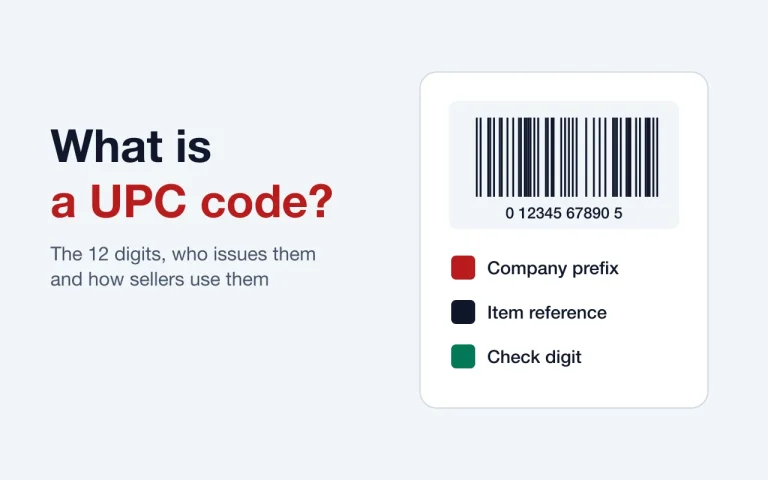
A UPC is a 12-digit Global Trade Item Number (GTIN-12). The first block of digits is a GS1 company prefix, the middle block is an item reference, and the last digit is a check digit. Who licensed the prefix is what the whole GS1 vs reseller question comes down to.
A GS1 company prefix is a block of numbers licensed to one company. From GS1 you get the prefix itself, the right to build as many codes as its capacity allows.
A reseller code is one specific, finished UPC taken from a prefix that another company licensed from the Uniform Code Council (UCC, now GS1 US) before August 28, 2002. Under a 2004 class action settlement, companies that joined the UCC before that date are “not obligated to pay membership renewal dues,” as Supermarket News reported in February 2004. That’s why resold codes carry no yearly fee.
The help article on where reseller codes come from goes through the history in more detail.
What each source gives you
| Source | What you get | Renewal | Entry price |
|---|---|---|---|
| GS1 US single GTIN | One code | None | $30 |
| GS1 US company prefix | A prefix for 10 to 100,000 codes | Yearly | $250 plus $50 a year (10 codes) |
| Reseller | Specific finished codes, no prefix | None | A few dollars per code |
| Free generator | A number with a valid check digit | None | $0 |
| eBay or marketplace lot | Unknown | Unknown | Varies |
Buying from GS1
GS1 is the non-profit standards body that issues barcode numbers, and each country has its own office. For a US business, that office is GS1 US.
GS1 US prices
GS1 US sells two products. The single GS1 US GTIN costs $30 once, with “no annual renewal fee,” and includes GS1 US Data Hub for managing product data, according to GS1 US’s pricing page. It isn’t available for pharmaceuticals, variable measure products, mixed cases or coupons.
The company prefix tiers, from the same page:
| Codes | Initial fee | Annual renewal |
|---|---|---|
| 10 | $250 | $50 |
| 100 | $750 | $150 |
| 1,000 | $2,500 | $500 |
| 10,000 | $6,500 | $1,300 |
| 100,000 | $10,500 | $2,100 |
Drug makers have a separate prefix that includes an FDA NDC labeler code, at $2,100 initial and $2,100 a year. GS1 US notes it can change prices at any time, so check the page before you budget.
The single GTIN is the part most guides skip. If you have one to nine products and a channel that wants GS1 codes, $30 per product with no renewal is the cheapest official route in the US. Ten single GTINs cost $300 once, while the 10-code prefix costs $250 up front plus $50 every year after, which passes $300 by the second renewal.
What GS1 costs over five years
For a brand with 10 products, here’s what each route costs over five years, using the prices above:
| Option | Five-year cost |
|---|---|
| GS1 US, ten single GTINs | $300 |
| GS1 US, 10-code prefix | About $450 to $500 (depends on when renewals start) |
| Reseller, 10 codes from GetUPCCode | $15 |
The gap is real, and for most sellers a one-time reseller pack is the simpler way to start.
Buying from a reseller
A reseller sells individual codes from prefixes licensed before the 2002 cutoff. You get finished numbers ready to use, paid once, with no yearly fee.
GS1 itself doesn’t vouch for resellers. GS1 Australia’s FAQ says it “has no relationship with these resellers,” can’t confirm that their numbers are unique, and that buying from one is at your own risk. That’s a fair warning, and it’s why the reseller you pick matters.
What you get from GetUPCCode
Here’s exactly what a GetUPCCode order includes, so you can compare it with anyone else:
- Specific UPC codes from UCC prefixes licensed before August 28, 2002, with no yearly fee.
- Each code sold once and never resold. A faulty code gets replaced. Orders can’t be refunded once placed.
- Delivery by email, usually within 15 minutes of payment and at most 6 hours. Nothing ships.
- An Excel spreadsheet and a PDF of your numbers, barcode images in a ZIP, UPC and EAN-13 versions together, and a PDF invoice.
- PayPal or Razorpay, guest checkout, no account needed.
- Support at [email protected], with replies within 24 hours.
Prices are one-time: 1 code $4.59, 5 for $9.99, 10 for $15, 25 for $24.75, 50 for $33.49, 100 for $44, 500 for $123, 1,000 for $225 and 10,000 for $775, with packs up to 100,000. The coupon SPECIAL takes 10% off orders of 25 codes or more. Current prices are on the buy UPC codes page. If you are comparing resellers, we put our offer next to a well-known one in UPCs.com vs GetUPCCode.
What you don’t get: a company prefix of your own.
Where reseller codes make sense
Reseller codes fit channels that need a valid, unique number and don’t check who licensed it. That covers most eBay listings that need a code, Shopify and your own store, Google Shopping feeds, Etsy listings that ask for one, and many small shops and boutiques that scan for inventory. They also suit internal stock control, where nobody outside your business reads the code.
For Amazon, it’s a judgment call. Some sellers list fine with resold codes, others get flagged, and Amazon’s written policy favors GS1. If Amazon is where your money is, read the next section before you buy from anyone, us included.
Free or generated numbers
A UPC generator or check digit calculator can make a 12-digit number that looks valid. The check digit math is public, so any tool can produce a number that passes a basic format check. That doesn’t make it yours.
A made-up number isn’t licensed to anyone you know. It might already belong to a real brand’s product, or GS1 could license that prefix to someone else later. Google’s own rule for Merchant Center is blunt: “Don’t guess or make up a value. If you’re unsure of a GTIN, don’t submit one” (Google Merchant Center help).
There are two legitimate free routes. If you resell another brand’s goods, the barcode already on the package is the one to use. If you sell private label on Amazon with no barcode on the product, Amazon’s GTIN exemption lets you list without one. Google takes brand plus MPN for private label products without a GTIN.
Codes from eBay and marketplace sellers
You’ll find lots of 100 or 1,000 UPCs on eBay and similar sites for very little. Some come from the same pre-2002 prefixes resellers use. Others have been sold to several buyers, pulled from old product lines or simply made up.
The problem is that you can’t tell which. There’s usually no stated prefix origin, no replacement policy and no one to email when two sellers turn up with the same number. In one Seller Forums thread a seller found a “fraudulent seller” already listing products under codes they’d bought, and put together proof of ownership for Amazon, hoping it would “free up my barcodes.” That case ended well because the seller’s vendor stepped in. With an anonymous lot, nobody will.
Our advice: skip them. A few dollars saved on a code that might be a duplicate isn’t worth a listing you can’t fix.
Red flags before you pay any seller
Run through this list with any barcode seller, including sites that look official:
- A promise that Amazon or Walmart will always accept them. Nobody outside those companies can promise that.
- No explanation of where the codes come from. A real reseller can tell you the codes come from pre-2002 UCC prefixes.
- A yearly fee on resold codes. The whole point of pre-2002 codes is that no renewal is owed. A reseller charging a subscription is charging for something else.
- No replacement policy for a faulty or duplicate code.
- A price far below everyone else on an auction site, with no business name, contact address or invoice.
- “Free UPC” generators presented as licensed codes.
- A site designed to look like GS1. In the US, the real address is gs1us.org.
How to check a code before you use it
Spend two minutes on this before you print anything. It works for codes from any source.
- Search the full 12-digit number on Verified by GS1. It should return a valid GS1 record.
- Search the number on Amazon and in Google. If a product from another brand comes up, don’t use that code.
- Confirm the check digit with any UPC check digit calculator.
- Keep your invoice and the code list together. If a dispute comes up, that’s your proof of purchase.
When GS1 is the right buy, even though we sell reseller codes
Go straight to GS1 in these cases. We’d rather lose the sale than sell you codes that will cause a relisting job later.
You sell on Walmart Marketplace
Walmart requires a valid product ID on every listing. Our Walmart UPC requirements article covers the details.
You’re pitching a retail chain
Retail chains each set their own barcode rules. Ask the buyer which they need before you buy anything. The retail store barcode requirements guide walks through a typical onboarding checklist.
Amazon is your main channel and you own the brand
Brand Registry needs a trademark and your brand on the product, not a particular barcode (Amazon Brand Registry).
You plan to sell through distributors
If wholesale is in your two-year plan, starting on GS1 saves you from relabeling stock and relisting products later.
You sell pharmaceuticals
GS1 US doesn’t sell its single GTIN for pharmaceuticals and has a separate prefix with an FDA NDC labeler code.
The cheap way into GS1
For one to nine products, the GS1 US single GTIN at $30 each with no renewal is hard to argue with. That’s a small line item for a brand headed for store shelves.
When a reseller code is the sensible buy
Buy reseller codes when your channels don’t check the licensee and yearly fees would eat your margin. Typical cases:
- You sell on eBay, Etsy, Shopify or your own site and the platform asks for a code.
- You run a small line of many variants (say 40 sizes and colors of one T-shirt) and each needs its own number.
- You want codes for stock control in your own warehouse or shop.
- You’re testing a product before you commit to a brand, and you know you may switch to GS1 later.
If you later move into Walmart or a retail chain, you can license a GS1 prefix then and assign new codes to the products going into those channels. Plan for new packaging when you do. The GS1 vs reseller help article has a shorter side-by-side if you need it for a quick decision.
How many codes to buy
You need one code per sellable variant. A candle in three scents and two sizes is six products and six codes. Multipacks sold as their own unit (a 3-pack, a gift set) need their own codes too.
Buy a few more than your current line. Packs of 10 or 25 cost little more than 5, and you’ll want spare numbers the next time you add a color.
Frequently asked questions
Where is the best place to buy UPC codes?
The best place depends on where you sell. Buy from GS1 US if you want your own company prefix. For Amazon, eBay, Etsy, Shopify and your own site, a reputable reseller of pre-2002 codes costs far less and has no renewal fees.
Is it legal to buy UPC codes from a reseller?
Yes. Resellers sell codes from prefixes licensed by the Uniform Code Council before August 28, 2002. A 2004 class action settlement freed those companies from renewal dues, which is why the codes carry no yearly fee.
Does Amazon accept UPC codes from resellers?
Yes. Our codes are GS1-originated and valid, so list one code per product variation as normal.
Does Walmart accept reseller UPC codes?
Walmart requires a valid product ID on every listing.
Can I make my own UPC code for free?
You can generate a number with a valid check digit, but it isn’t licensed to you and may already belong to another brand’s product. Google tells merchants never to make up a GTIN. The legitimate free options are using the manufacturer’s barcode on goods you resell, or an Amazon GTIN exemption for private label products without barcodes.
Do I need to buy a UPC if I resell another brand’s product?
No. If the product already carries a barcode from its manufacturer, list it under that code, because the brand owner assigned it and it identifies that exact item. Buying a new code for someone else’s product only confuses the catalog. You need your own codes only for products you make, brand or bundle yourself.
Do UPC codes need to be renewed?
It depends on the source. The GS1 US single GTIN has no renewal fee, while GS1 US company prefixes charge yearly. Reseller codes from pre-2002 UCC prefixes owe no renewal, so you pay once.